
Software Testing Week 2 Assignment Answers
Software Testing Week 2 Assignment Answers
Course Link : Click Here
1. Which one of the following is an implicit assumption made in equivalence class testing?
a. A program behaves in similar ways to every input value belonging to an equivalence class.
b. Different equivalence classes of a program contain similar bugs
c. Different equivalence classes of a program contain dissimilar bugs
d. Equivalence classes define the behaviorally similar components of a program
e. Equivalence classes define the behaviorally similar code segments of a program
Answer : a
2. Consider a function that takes an integer a (which can assume integral values between 0 to 100) as an argument and carries out actions involving displaying the value of a variable b as specified in the following table.
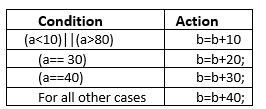
During black box testing of the function, how many valid equivalence class test cases need to be designed?
a. 4
b. 5
c. 6
d. 7
e. 8
Answer : b
3. On a customer telephone call, a tele-customer service software plays a voice message to describe five types of tele-service that are available, and requests the customer to enter a number between 1 and 5 to avail the different tele services. Entering a 0 repeats the voice message describing the services. Entering any other number terminates the call. How many equivalence classes can be designed to test the tele-customer service software based on the given information?
a. 5
b. 6
c. 7
d. 8
e. 9
Answer : c
4. Which of the following statements are TRUE about Cause–Effect Graph based testing?
a. It helps identify logical relationships between input conditions and their outcomes.
b. It is mainly used to design test cases from use case diagrams without considering conditions.
c. It uses Boolean logic to represent dependencies between causes and effects.
d. It can be converted into decision tables for structured test case generation.
e. It is only applicable when the software is already implemented and cannot be applied at the requirements level.
Answer : a, c, d
5. Consider a function named solver that solves a quadratic equation of the form ax2+bx+c=0, where a, b, and c are floating-point numbers. At least how many test cases are needed for equivalence class testing of the function solver, considering only valid equivalence classes?
a. 2
b. 3
c. 4
d. 5
e. 9
Answer : b
6. Consider a function named compute-grade that computes the grade of a student based on his attendance and the total marks obtained out of 100. If the attendance is below 80%, the student is assigned “F” grade irrespective of the marks scored. If the attendance of a student is 80% or more, the student with mark M is assigned a grade from EX, A, B, C, D, P, F depending upon whether M>89%, 90%>M>79%, 80%>M>69%, 70%>M>59%, 60%>M>49%, 50%>M>29%, or M<30%. If the decision making about the grade computation is represented in the form of a decision table, how many test cases are needed for decision table testing?
a. 6
b. 7
c. 8
d. 10
e. 12
Answer : c
7. If a user interface has two check boxes, at least how many test cases are required to achieve pair-wise coverage?
a. 3
b. 4
c. 5
d. 6
e. 7
Answer : b
8. Consider the function find-intersection(m1,c1,m2,c2) that computes the point of intersection of two straight lines of the form y=mx+c. For equivalence class testing, at the first level of the equivalent class hierarchy the valid and invalid equivalence classes can be formed. The valid set of input values can be further divided into how many equivalence classes?
a. 1
b. 2
c. 3
d. 4
e. 5
Answer : c
9. Which of the following statements correctly describe Boundary Value Testing?
a. It designs test cases based on values at or near the edges of input domains.
b. It ignores valid boundary values and tests only invalid inputs.
c. It often includes tests at minimum, minimum+1, maximum−1, and maximum values.
d. It is more effective when input domains are continuous or ordered.
e. It can be applied only to numeric inputs and not to strings or lengths.
Answer : a, c, d
10. Which of the following statements correctly describe Decision Table–based Testing?
a. It is useful when multiple input conditions interact to produce different outcomes.
b. It ignores combinations of conditions and tests only individual inputs independently.
c. It can be used to systematically derive test cases from specifications or business rules.
d. It often reveals missing rules or contradictions in the requirements.
e. It is applicable only when numeric calculations are involved and not for logical behaviors.
Answer : a, c, d
For other NPTEL Assignment Answer : Click Here